Easy Way to Tell How Many Consonants Are in a Word
Count consonants in a string (Iterative and recursive methods)
Given a string, count total number of consonants in it. A consonant is a English alphabet character that is not vowel (a, e, i, o and u). Examples of constants are b, c, d, f, g, ..
Examples :
Input : abc de Output : 3 There are three consonants b, c and d. Input : geeksforgeeks portal Output : 12
1. Iterative Method
C++
#include <iostream>
using namespace std;
bool isConsonant( char ch)
{
ch = toupper (ch);
return !(ch == 'A' || ch == 'E' ||
ch == 'I' || ch == 'O' ||
ch == 'U' ) && ch >= 65 && ch <= 90;
}
int totalConsonants(string str)
{
int count = 0;
for ( int i = 0; i < str.length(); i++)
if (isConsonant(str[i]))
++count;
return count;
}
int main()
{
string str = "abc de" ;
cout << totalConsonants(str);
return 0;
}
Java
import java.io.*;
class GFG {
static boolean isConsonant( char ch)
{
ch = Character.toUpperCase(ch);
return !(ch == 'A' || ch == 'E' ||
ch == 'I' || ch == 'O' ||
ch == 'U' ) && ch >= 65 && ch <= 90 ;
}
static int totalConsonants(String str)
{
int count = 0 ;
for ( int i = 0 ; i < str.length(); i++)
if (isConsonant(str.charAt(i)))
++count;
return count;
}
public static void main(String args[])
{
String str = "abc de" ;
System.out.println( totalConsonants(str));
}
}
Python3
def isConsonant(ch):
ch = ch.upper()
return not (ch = = 'A' or ch = = 'E' or
ch = = 'I' or ch = = 'O' or
ch = = 'U' ) and ord (ch) > = 65 and ord (ch) < = 90
def totalConsonants(string):
count = 0
for i in range ( len (string)):
if (isConsonant(string[i])):
count + = 1
return count
string = "abc de"
print (totalConsonants(string))
C#
using System;
class GFG {
static bool isConsonant( char ch)
{
ch = Char.ToUpper(ch);
return !(ch == 'A' || ch == 'E' ||
ch == 'I' || ch == 'O' ||
ch == 'U' ) && ch >= 65 && ch <= 90;
}
static int totalConsonants(String str)
{
int count = 0;
for ( int i = 0; i < str.Length; i++)
if (isConsonant(str[i]))
++count;
return count;
}
public static void Main()
{
String str = "abc de" ;
Console.Write( totalConsonants(str));
}
}
PHP
<?php
function isConsonant( $ch )
{
$ch = strtoupper ( $ch );
return !( $ch == 'A' || $ch == 'E' ||
$ch == 'I' || $ch == 'O' ||
$ch == 'U' ) && ord( $ch ) >= 65 && ord( $ch ) <= 90;
}
function totalConsonants( $str )
{
$count = 0;
for ( $i = 0; $i < strlen ( $str ); $i ++)
if (isConsonant( $str [ $i ]))
++ $count ;
return $count ;
}
$str = "abc de" ;
echo totalConsonants( $str );
return 0;
?>
Javascript
<script>
function isConsonant(ch)
{
ch = ch.toUpperCase();
console.log(ch);
return (
!(ch == "A" || ch == "E" || ch == "I" || ch == "O" || ch == "U" ) &&
ch.match(/[A-Z]/i)
);
}
function totalConsonants(str) {
var count = 0;
for ( var i = 0; i < str.length; i++)
if (isConsonant(str[i])) ++count;
return count;
}
var str = "abc de" ;
document.write(totalConsonants(str));
</script>
Time Complexity: O(n), where n is the length of the string
Auxiliary Space: O(1)
2. Recursive Method
C++
#include <iostream>
using namespace std;
bool isConsonant( char ch)
{
ch = toupper (ch);
return !(ch == 'A' || ch == 'E' ||
ch == 'I' || ch == 'O' ||
ch == 'U' ) && ch >= 65 && ch <= 90;
}
int totalConsonants(string str, int n)
{
if (n == 1)
return isConsonant(str[0]);
return totalConsonants(str, n - 1) +
isConsonant(str[n-1]);
}
int main()
{
string str = "abc de" ;
cout << totalConsonants(str, str.length());
return 0;
}
Java
import java.util.*;
import java.lang.*;
class GFG
{
static boolean isConsonant( char ch)
{
ch = Character.toUpperCase(ch);
return (ch == 'A' || ch == 'E' ||
ch == 'I' || ch == 'O' ||
ch == 'U' )== false && ch >= 65 && ch <= 90 ;
}
static int totalConsonants(String str, int n)
{
if (n == 1 )
{
if (isConsonant(str.charAt( 0 )))
return 1 ;
else
return 0 ;
}
if (isConsonant(str.charAt(n - 1 )))
return totalConsonants(str, n - 1 ) + 1 ;
else
return totalConsonants(str, n - 1 );
}
public static void main(String args[])
{
String str = "abc de" ;
System.out.println(totalConsonants(str, str.length()));
}
}
Python3
def isConsonant(ch):
ch = ch.upper()
return not (ch = = 'A' or ch = = 'E' or
ch = = 'I' or ch = = 'O' or
ch = = 'U' ) and ord (ch) > = 65 and ord (ch) < = 90
def totalConsonants(string, n):
if n = = 1 :
return isConsonant(string[ 0 ])
return totalConsonants(string, n - 1 ) + isConsonant(string[n - 1 ])
string = "abc de"
print (totalConsonants(string, len (string)))
C#
using System;
class GFG
{
static Boolean isConsonant( char ch)
{
ch = char .ToUpper(ch);
return (ch == 'A' || ch == 'E' ||
ch == 'I' || ch == 'O' ||
ch == 'U' ) == false &&
ch >= 65 && ch <= 90;
}
static int totalConsonants(String str, int n)
{
if (n == 1)
{
if (isConsonant(str[0]))
return 1;
else
return 0;
}
if (isConsonant(str[n - 1]))
return totalConsonants(str, n - 1) + 1;
else
return totalConsonants(str, n - 1);
}
public static void Main(String []args)
{
String str = "abc de" ;
Console.WriteLine(totalConsonants(str, str.Length));
}
}
Javascript
<script>
function isConsonant(ch)
{
ch = ch.toUpperCase();
return (!(ch == 'A' || ch == 'E' ||
ch == 'I' || ch == 'O' ||
ch == 'U' ) && ch.charCodeAt(0) >= 65 &&
ch.charCodeAt(0) <= 90) ;
}
function totalConsonants(str, n)
{
if (n == 1)
return isConsonant(str[0]);
return totalConsonants(str, n - 1) +
isConsonant(str[n - 1]);
}
var str = "abc de" ;
document.write(totalConsonants(str,str.length));
</script>
Time Complexity: O(n), where n is the length of the string
Auxiliary Space: O(1)
Illustration of recursive method:
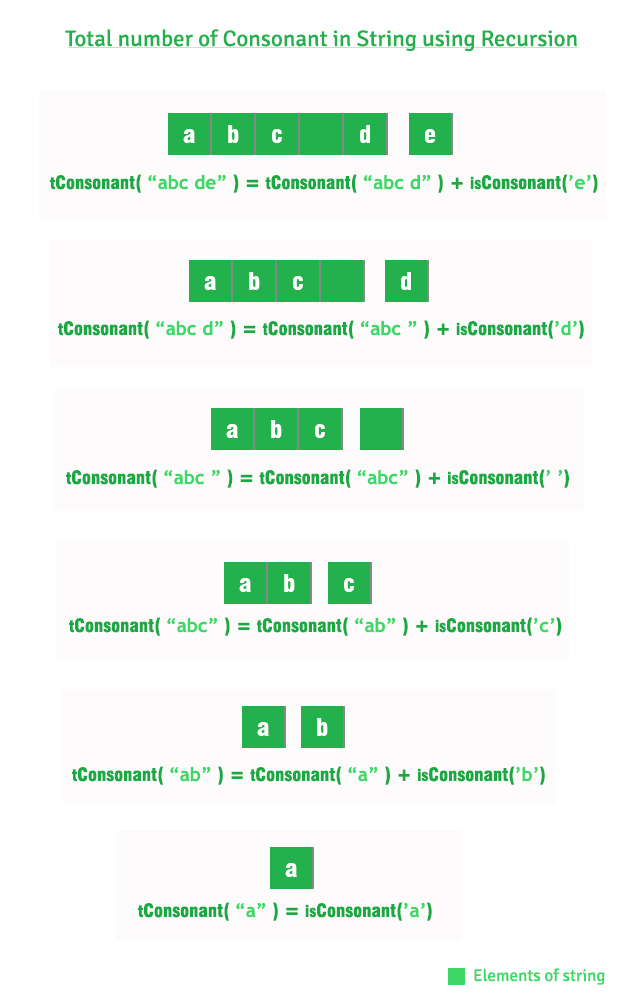
Source: https://www.geeksforgeeks.org/count-consonants-string-iterative-recursive-methods/

Post a Comment for "Easy Way to Tell How Many Consonants Are in a Word"